
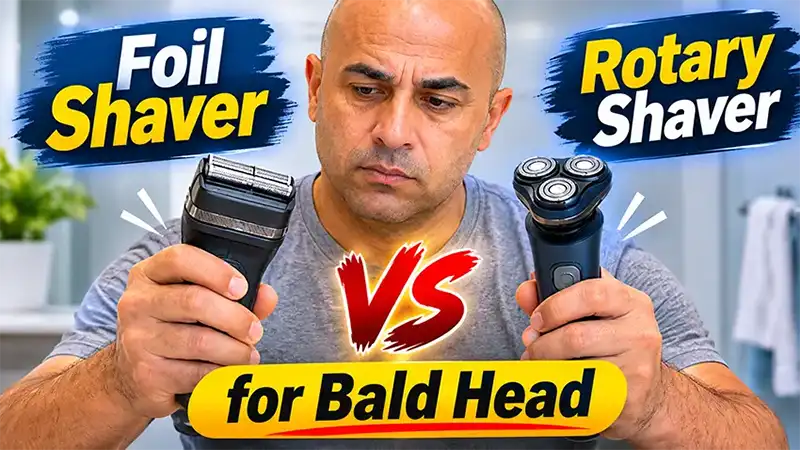
Choosing a foil shaver vs rotary for bald head maintenance starts with the finish you want and how easily you can reach your whole scalp. A close shave across the front is only part of the job. You also need comfortable handling around the crown, behind the ears and at the nape.
Consider rotary models designed for scalp shaving if coverage and reach are your priorities. Foil models may be a better starting point if you want a close finish on short stubble. However, these are general guidelines, not proven advantages of either category.
Don’t focus on the cutting system alone. Also consider the grip, whether the manufacturer approves the device for scalp use, and how comfortable it feels during shaving.
Key takeaways
- Consider scalp-focused rotary models for coverage and reach, and scalp-suitable foil models for close short-stubble finishing, without assuming either category guarantees better results.
- Before you buy, check the maker’s rules for scalp use. Make sure the shaver works with your hair length and fits your usual shaving routine.
- Neither rotary nor foil shavers are known to be gentler for everyone. If you often get ingrown hairs, try not to shave too close. See a doctor if the problem keeps coming back.
- Don’t look at the price alone. Check how easy it is to clean, how it charges, and whether spare parts are easy to find. Read the return policy before you buy.
Table of Contents:
Foil shaver vs rotary for bald head: the quick answer
Start with the part of shaving you find most difficult. If reaching the back of your head feels awkward, consider scalp-focused rotary shavers with an easy-to-control grip. If you maintain very short stubble and prefer a close finish, add scalp-suitable foil shavers to your shortlist.
Neither type guarantees a closer, faster, or more comfortable shave. Look at the complete design before choosing. Consider the handle, cutting-head movement, overall size, and manufacturer’s instructions for scalp use.
Also separate two different jobs:
- Maintaining an already shaved scalp means dealing with short regrowth and checking for missed patches.
- Removing longer hair requires checking whether you need clippers or a trimmer before using a finishing shaver.
If you are moving from a grown-out haircut to a shaved head, plan your preparation before comparing finishing systems. Check the shaver’s intended hair length so you know whether you will need another tool first.
How foil and rotary head shavers differ:
A foil shaver has cutters that move back and forth beneath a thin, perforated metal foil. Hair enters the openings so the cutters can trim it. A rotary shaver has rotating cutters beneath circular guards, with openings that admit hair to the cutting surfaces.
The cutting mechanism tells you little about how a particular tool will feel in your hand. A foil shaver can have a flexible head assembly; the word “foil” does not mean every part is rigid. Likewise, circular rotary heads alone do not establish how well a device will reach your nape.
Compare the intended job as well:
| Device description | What to verify |
|---|---|
| Dedicated head shaver | Scalp instructions, grip and access around ears and nape |
| Facial electric shaver | Whether the manufacturer permits scalp use |
| Barber finishing shaver | Intended hair length and any pre-trimming requirement |
Straight, controlled strokes are commonly used with foil shavers. Rotary shavers generally use circular motions. However, always follow the instructions for your specific model. Different devices may require different techniques and pressure.
Before buying, look for product photos or demonstrations from multiple angles. Pay particular attention to the handle and grip. A front-facing product photo won’t show whether you can comfortably reach the controls when holding the shaver behind your head.
Foil vs rotary head shavers: closeness, coverage and reach:
Closeness describes the finish in an area you have shaved. Coverage describes how you work across the whole scalp. Liking the finish on your forehead does not establish that the same tool will be easy to guide around the back.
Use these checks when comparing individual foil and rotary models:
| Priority | What to examine | Useful question |
|---|---|---|
| Close finish | Intended finishing use and suitable stubble length | Does it suit the finish I want at my usual shaving interval? |
| Scalp contours | Head movement and flexible mounts | Can I maintain contact without pressing harder? |
| Back-of-head reach | Handle shape, palm grip and control placement | Can I hold it comfortably at the nape? |
| Work around ears | Cutting-head size and visibility | Can I position it accurately in a small area? |
| Missed patches | Ability to make controlled touch-ups | Can I revisit one spot without covering a much larger area? |
| Cleaning access | Opening or removal procedure | Can I reach the places where hair collects? |
| Ongoing upkeep | Replacement cutters, foils or guards | Can I buy the correct parts locally? |
Avoid treating “foil cuts closer” or “rotary is faster” as guaranteed scalp results. Those claims would need comparable scalp testing; neither is established as a category-wide advantage.
If possible, assess the grip in person. Otherwise, examine dimensions, demonstrations and return terms. Consider how you would move from the crown to the nape, including whether you would need to change hands.
Choose a head shaver around your regrowth and routine:
Build your comparison around your regular shaving schedule. Someone who maintains short stubble frequently has different needs from someone who goes several days between shaves.
If you shave frequently, check whether the model is designed to handle your usual hair length. Make sure its grip and handling suit your routine. Also consider how smooth you want the final result to feel. The right level of closeness is a personal preference. It isn’t the same for everyone.
If you wait several days between shaves, check how long the hair can be before shaving and whether you need to trim it first. Don’t assume a rotary shaver can handle several days of growth just because it has round heads. Some finishing shavers can’t cut long hair. Use a trimmer or clippers to shorten it before you shave.
Before choosing, answer four questions:
- How often will I realistically shave?
- How close do I want the finish to feel?
- Am I willing to pre-trim when needed?
- Do I already own a suitable preparation tool?
For example, an occasional head shaver who already owns clippers might accept a two-stage routine. Someone seeking frequent, simple maintenance might prefer one scalp-suitable device that handles their usual short regrowth.
Foil or rotary: which is better for a sensitive scalp?
Neither foil nor rotary shavers are known to be gentler on the scalp. There is also no clear proof that one type helps prevent ingrown hairs better than the other. Comfort depends on the shaver and how you use it.
Use light pressure and follow the maker’s instructions. Stop if your skin starts to hurt. Don’t shave the same spot over and over just to get a perfectly smooth finish. Some hair may remain, and that’s okay. Take a break and check the hair length, your shaving method, and the condition of the blades.
Ingrown hairs are more than simple shaving irritation. According to the Mayo Clinic’s guide to ingrown hairs, shaved hair can grow back into the skin. A very close shave may raise the risk. The Mayo Clinic advises seeing a doctor if the problem doesn’t go away or keeps coming back. Keep in mind that this is general advice. It does not prove that foil or rotary shavers are better at preventing ingrown hairs on the scalp.
If you often get ingrown hairs, try shaving less close to the skin. Changing from a foil to a rotary shaver may not fix the problem on its own.
Wet shaving is another option, but check the maker’s guide first. Make sure the exact model allows the type of water use and shaving products you plan to use. A removable head that can be washed does not mean the whole shaver is safe to use with water.
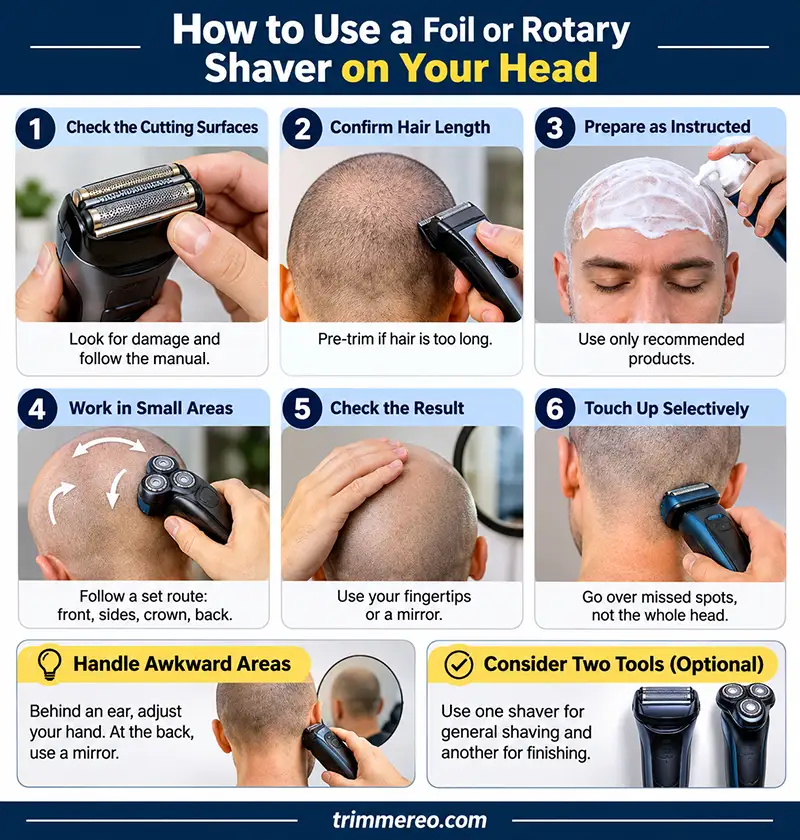
How to use a foil or rotary shaver on your head
A consistent route across your scalp makes it easier to track what you have covered. Adapt these steps to the device’s instructions:
- Check the cutting surfaces. Inspect the foil or guards for damage, and follow the manufacturer’s directions if anything needs replacement.
- Confirm the hair length. Pre-trim when the growth exceeds the shaver’s intended use.
- Prepare as instructed. Use the specified dry or wet preparation, including only permitted products.
- Work through small areas. Follow a repeatable route, such as front, sides, crown and back, using the recommended motion and light pressure.
- Check the result. Use your fingertips or a second mirror to locate patches around the crown and nape.
- Touch up selectively. Revisit the missed area instead of repeating the entire scalp shave, and stop if the skin becomes uncomfortable.
Give awkward areas time. Behind an ear, reposition your hand so you can control where the cutting head goes. At the back, use a mirror to check placement rather than relying entirely on how the movement feels.
You may prefer one tool for general shaving and another for finishing. That is an optional routine to evaluate if you already own both suitable tools. Try one shaver before deciding whether you need a second.
Compare cleaning, charging and long-term cost:
Check how to clean the shaver before you buy it. Find out how to open the head and remove trapped hair. See whether the maker recommends a brush, water, or another cleaning method. Follow the care steps for drying and oiling the blades.
Pay close attention to the water-resistance guide. A head that can be rinsed doesn’t mean you can use the whole shaver for wet shaving or in the shower. Check the maker’s instructions to see which parts can get wet and whether the shaver is safe for the way you plan to use it.
For ownership costs, record the following for each shortlisted model:
| Item | What to check |
|---|---|
| Purchase | Device price and included accessories |
| Cutting parts | Correct replacement foil, guard or cutter set and its price |
| Availability | A supplier that delivers to your location |
| Replacement guidance | The manufacturer’s inspection and replacement instructions |
| Consumables | Any specified lubricant or cleaning supplies |
| Charging | Connector, required charger and included charging equipment |
| Battery use | Stated runtime, charge time and permitted plugged-in operation |
Don’t assume that either type of shaver needs more frequent part changes or costs less to maintain over time. Check the replacement parts and care instructions for the exact models you’re comparing.
Think about where you plan to keep your shaver. Make sure its charging setup fits that space. Do you want to shave while it’s plugged in? Check whether the maker allows it. Having a charging cable doesn’t mean you can use the shaver while it charges.
Foil vs rotary for a bald head: final buying checklist
Choose a shortlist around the feature you most need to improve:
- For better coverage and reach: Look at shavers made for scalp use, including rotary models. Check the grip, how the head moves, and how easy it is to reach the back of your neck.
- For a closer shave: Consider foil shavers approved for scalp use. Check the shortest hair length they can handle and whether you need to trim your hair first.
- For more comfort: Make sure the shaver is approved for scalp use and easy to hold. Choose one that feels comfortable to control. Start slowly and see how your skin reacts. Neither foil nor rotary shavers are more comfortable for everyone.
If you already own an electric shaver, check whether the maker allows it for scalp shaving before buying a new one. If it does, see how well it shaves, how easy it is to reach all areas, and how much care it needs. Think about what you don’t like about your current shaver. This can help you find a new one that fixes those problems.
Check whether you can easily find replacement parts. Read the return policy, too. Some sellers may not accept grooming tools once the package is open or the device has been used. Comfort and reach can also be hard to judge from product specs alone, especially when shaving the back of your head.
For more help, explore Trimmereo’s grooming reviews and buying guides. You’ll find more comparisons of electric shavers, trimmers, and other grooming tools.
Leave a Reply